How to Do Comedy
Malhar Kulkarni · June 14, 2026
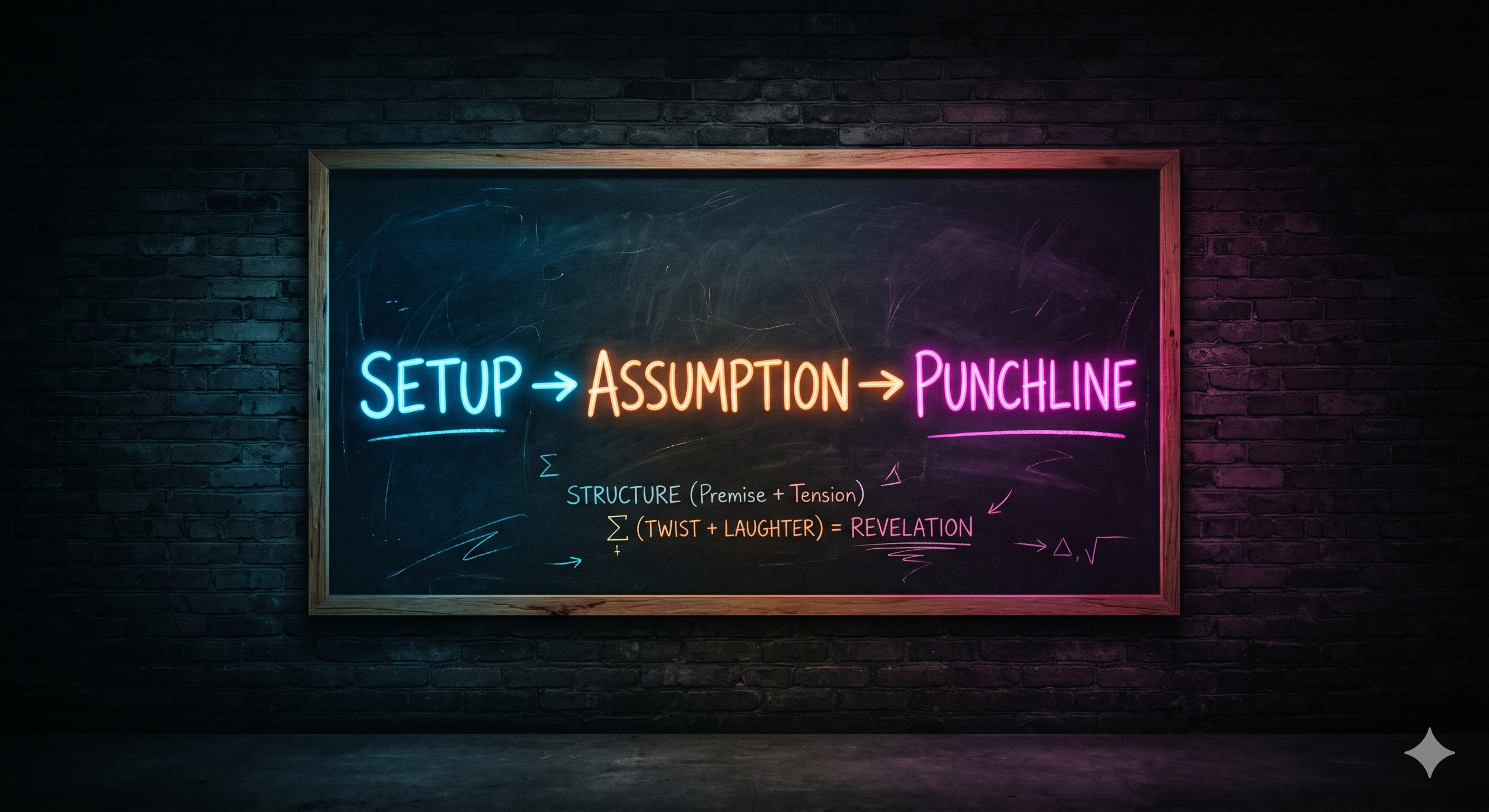
I used to think comedy was something people were born with. Then I watched Samay Raina teach chess Grandmaster Vidit Gujrathi how to be funny in one sitting. Comedy is not a personality trait. It is a formula. Here is the formula.
The Equation
Every joke is just one equation: Setup + Assumption + Punchline. The setup feeds the audience information. Their brain takes the laziest logical path and builds an assumption automatically. The punchline destroys that assumption. The gap between what they expected and what you said is the laugh. The bigger the gap, the bigger the laugh.
The punchline cannot be slightly different from the assumption. It must be the extreme opposite. "He threw his son in the water to teach him to swim" — that is the assumption. "He threw him in to teach himself CPR" — that is the break. The son's survival versus the father's medical training. Maximum distance. Maximum laugh.
Timing is a Variable
Timing is not a vibe. It is a variable. The pause between the setup and the punchline is called the beat. Too short, the assumption hasn't formed. Too long, the tension dies. You find the right beat the same way Grandmasters find the right move — you test it, record it, measure it, and iterate. Comedians carry voice recorders. They measure Laughs Per Minute the way engineers measure throughput.
The Excel Sheet
Your story needs to be tight. Samay literally uses an Excel sheet. Every sentence goes into one of four columns: Premise, Setup, Punchline, or Tag. If a sentence doesn't fit any column, it gets deleted. No exceptions. White space kills momentum. A tight set is a set with no white space.
The Tag
Jokes have sequels. After the punchline lands, the audience's brain is sitting in a new, broken reality. A tag is a second punch that exploits that same broken reality without rebuilding the setup. Strong comedians always hunt for the tag. Weak comedians stop at the first laugh.
The Uncomfortable Math
Here's the uncomfortable math. Only 40% of comedy is the writing. The other 60% is likability. An audience will not laugh at someone they don't like. A beloved performer can make mediocre material work. An unlikable performer will bomb structurally perfect jokes. Engineer your persona as carefully as your punchlines.
Editing is Where Comedy Happens
The editing process is where comedy actually happens. Cut the adjectives. Cut the filler. Cut the joke that's technically funny but costs you the crowd's trust. Samay cut a structurally perfect joke about MS Dhoni because the image was too offensive. The joke worked. The risk didn't. Knowing what to delete is a skill. Most people think editing is for writers. It's for anyone who wants to be understood.
Comedy is a discipline disguised as spontaneity. Build the assumption. Break it hard. Measure the gap. That's it.