Building Value in AI Era
Malhar Kulkarni · December 8, 2025

AI is doing to knowledge workers what robots did to assembly lines. AI commoditises mediocre cognitive work → innovation cycles are faster → the only durable edge is agency, judgment, and experimentation. Let's discuss how to stay valuable.
Intellectual Workers
We saw how robots replaced physical labour to a large extent on manufacturing assembly lines. The nature of such work was largely dependent on human muscles and precision of handling physical processes. Now the big tech businesses require a labour force good with thinking through different kinds of problems and solutions. From designing websites, developing scalable API gateways to visualizing 3D models of homes, managing accounts, etc. Most tasks which are repetitive, mundane, shallow, tedious, etc., can now be handed off to AI. If we draw parallels between the early age of robot adoption in a manufacturing company and AI adoption in a company requiring intellectual effort, AI is going to replace a lot of knowledge workers.
Adaptation is inevitable
Please don't rage-bait onto my last statement. :). As there are different levels of precision and granularity required in any physical task, from lifting heavy weights to delicately painting a masterpiece, there is a spectrum of expertise and skill at play. Similarly, there is a spectrum of skill and expertise at play in intellectual work as well. Look at your own day; the level of application of your mind to different activities varies based on the nature of thought required to complete a certain task at hand.
Thought is essentially a recycling of memory and experience just with a little tweak. We won't be going deep into what all the dimensions of a thought are in this article, perhaps a valuable discussion for the next one. But as physical workers evolved into new roles and responsibilities in their work, intellectual workers need to transform and adapt to the new reality of work as well. The only difference between the transformation window for physical workers adapting to new machines and technology and that for intellectual workers with AI is the shrinking innovation window.
Shrinking innovation window
The time difference between an idea to prototype, prototype to MVP (minimum viable product), MVP to scalable product has reduced dramatically. The research notes that innovation cycles "build upon each other, reducing the time taken between each milestone". The first Industrial Revolution wave took half a century, electrification took a few decades, and today's digital innovations happen in just a few years. This acceleration exists because modern tech needs less physical infrastructure (no cables, towers, pipes to install everywhere) and benefits from instant global connectivity and established digital platforms.
Innovation cycles are accelerating: what once took centuries now happens in years.
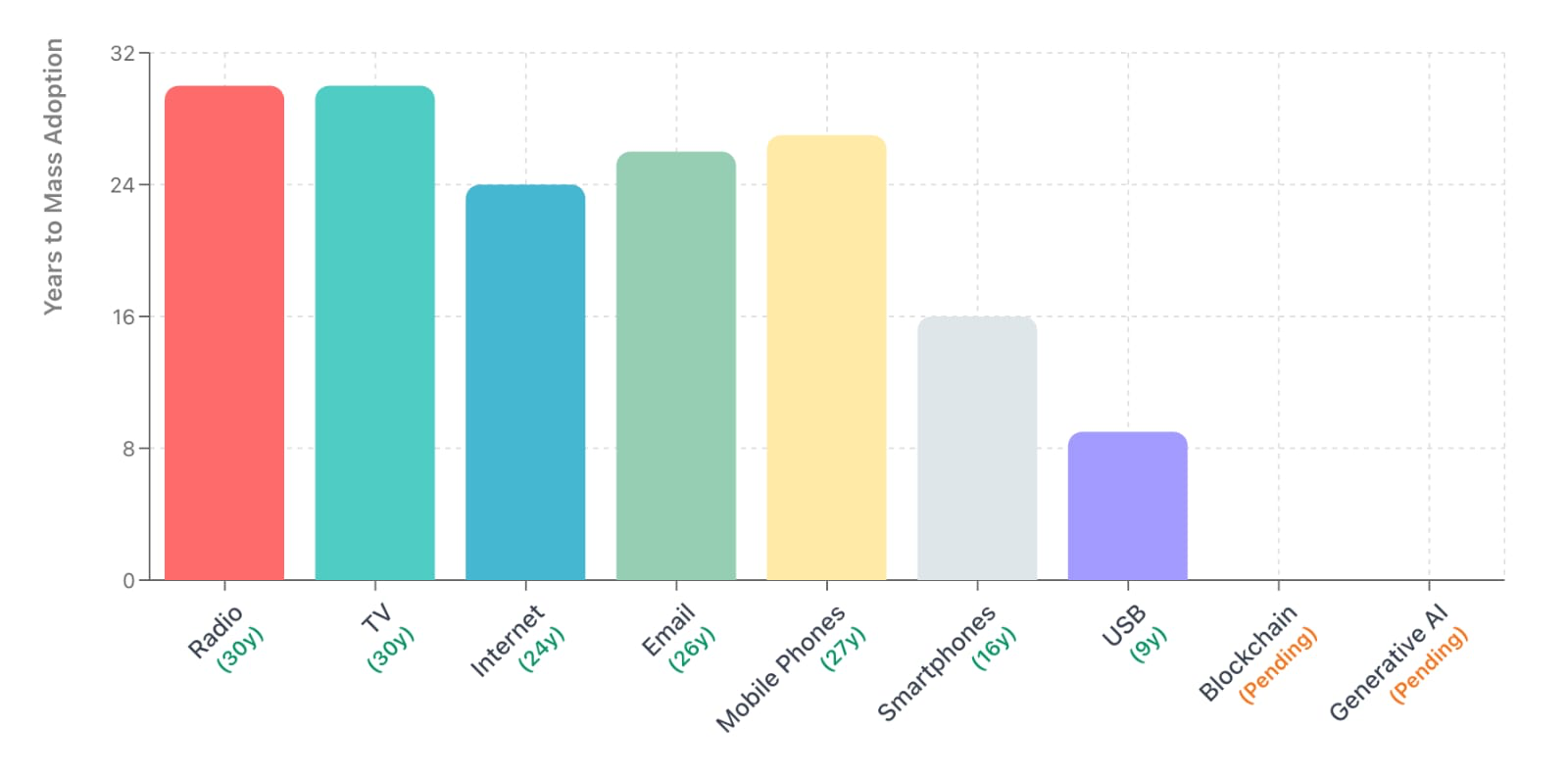
With this shrinking window of time, AI being the latest disruptor technology, we are witnessing new adoption challenges. Major bottlenecks for its adoption are curiosity in people, self-agency in individuals, public policy drawing the line between public rights vs privacy vs services (features) for its users, and wise long-term thinking leadership in innovators. The reason I'm calling these aspects bottlenecks is because of their scarcity and challenges. Even though AI has accelerated software development time, conversational user experience, personalised web search responses, and many more things, it is definitely not a substitute for conscious thinking, strategic actions, learning how to learn, knowing what to ignore, fundamental domain-specific knowledge, intense work, etc. What has changed definitely is the lowering of the entry barrier for people to generate images, video, audio, and text for a given context. To navigate in this AI era, it's very important to be "Open by default".
AI makes mediocre output abundant. When mediocrity is set as standard, rubbish is acceptable, acceptable becomes extraordinary and extraordinary becomes genius.
Open by default
In the world of AI agents, there's going to be serious scarcity of human agency.
- Own problems, not tasks. AI can execute; you need to decide what's worth executing. Your taste and judgment for your context is what separates you from mediocre labor.
- See the story, not just the pattern. AI sees patterns in data. You should see the story that ties data + people + time together.
- Fail fast, fail forward. When there's no "seasoned expert in AI," the only way to learn is through rapid experimentation. Share your thoughts early, seek critique, contribute to shared tools and open-source where possible—this builds reputation and surface area for luck.
Here's a game to build your vantage point:
Start here 🏁
- Find a repetitive, painful, or time-consuming task
- Try to solve it using freely available AI models
- Most importantly, notice where AI still needs you—your judgment, your context, your relationships. That's the zone to double-down on.
By doing this, you'll ramp up to a vantage point where you start seeing opportunities others miss. That's how you ride the wave of AI.
Namaskar 🙏